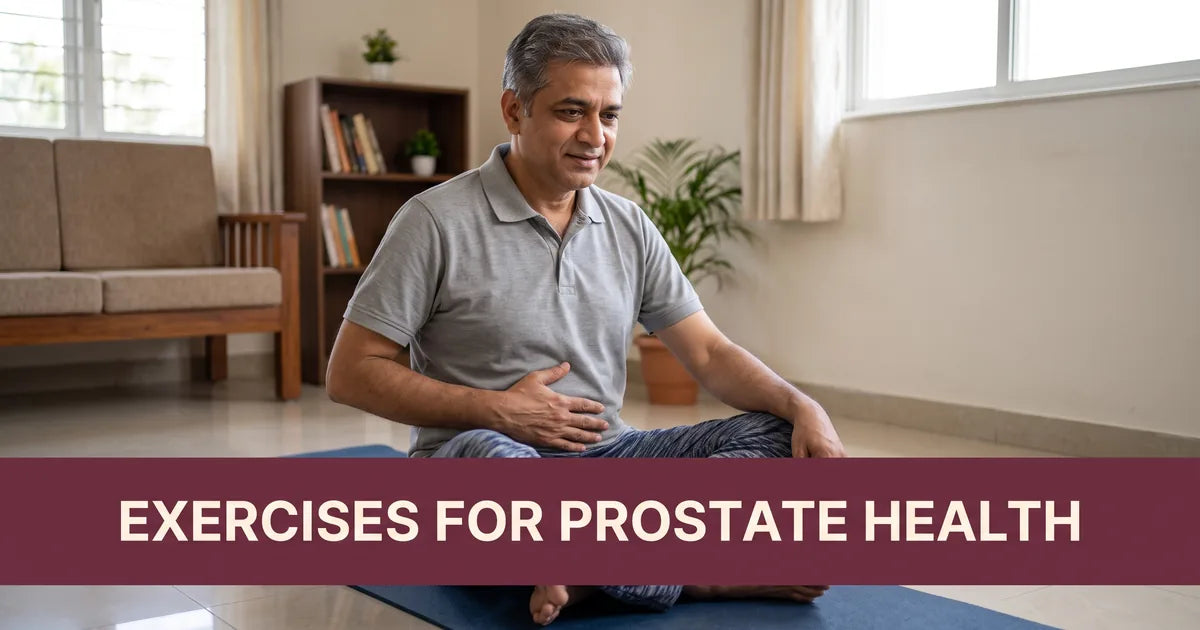
Exercises for Prostate Health: Simple Daily Moves
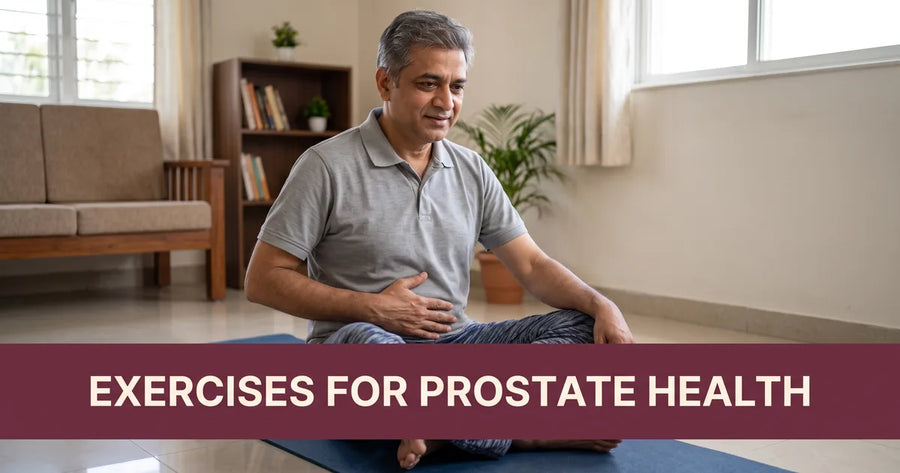
Exercises for Prostate Health: Simple Daily Moves
If you’re over 45 and waking up two or three times a night to urinate, or feel your urine flow isn’t what it used to be, you’re not alone — and you’re right to pay attention. Alongside a good diet, the right kind of movement can be a quiet, useful part of looking after your prostate.
This doctor-reviewed guide walks you through pelvic floor (Kegel) exercises, gentle yoga and everyday activity that are traditionally and clinically valued for supporting comfortable urination and men’s wellness — plus what to avoid, and when to see a doctor.
Key Takeaways
- Pelvic floor (Kegel) exercises are simple, free and can help support bladder control and urinary comfort in men.
- Regular aerobic activity like brisk walking, along with a healthy weight, supports overall prostate and urinary wellness.
- Gentle yoga asanas that ease the pelvis and lower abdomen are traditionally used to support men’s urinary health.
- Exercise supports comfort and wellbeing — it does not cure or shrink an enlarged prostate, which needs medical assessment.
- Ayurvedic herbs and lifestyle are traditionally used to support prostate and urinary wellness alongside, never instead of, a doctor’s care.
Can Exercise Really Help the Prostate?
Yes — in a supportive way. Research and continence guidance suggest that men who are physically active and keep a healthy weight tend to have fewer urinary symptoms, and that pelvic floor training can help with bladder control, dribbling after urination, and overall comfort.
What exercise cannot do is treat or reverse an enlarged prostate (BPH) or any prostate disease. Think of movement as one healthy habit that supports your urinary comfort — part of the picture, not a replacement for medical advice.
Pelvic Floor (Kegel) Exercises for Men
The pelvic floor muscles support the bladder and help control the flow of urine. Training them is one of the most practical things men can do for urinary comfort.
How to find the right muscles: The next time you urinate, briefly try to stop the flow mid-stream — the muscles you squeeze are your pelvic floor muscles. (Do this only to locate them, not as the regular exercise.)
How to do a Kegel:
- Sit or lie down comfortably and relax your stomach, thighs and buttocks.
- Squeeze the pelvic floor muscles and hold for 3–5 seconds.
- Relax fully for the same amount of time.
- Repeat 10 times, and aim for 3 sets a day.
- Breathe normally throughout — don’t hold your breath or tighten your tummy.
Consistency matters more than intensity. Many men notice a difference only after a few weeks of daily practice, so be patient.
Aerobic Exercise and a Healthy Weight
General fitness is good for the prostate too, largely because it supports healthy weight, blood flow and hormones:
- Brisk walking for 30 minutes most days is one of the easiest, joint-friendly options.
- Cycling is fine for most, but if you get numbness or pressure discomfort, use a well-padded or split saddle and take breaks.
- Swimming or light jogging keeps the heart and circulation healthy.
- Keeping a healthy waistline is linked with fewer urinary symptoms — belly fat is worth trimming for more reasons than one.
Gentle Yoga for Prostate & Urinary Wellness
Yoga is traditionally used in India to ease the pelvic region and support calm, comfortable urination. Gentle, doctor-friendly options include:
- Mula Bandha (root lock) — a yogic version of the pelvic floor squeeze.
- Baddha Konasana (butterfly pose) and Supta Baddha Konasana — open the hips and pelvis gently.
- Setu Bandhasana (bridge pose) — strengthens the pelvic floor and lower back.
- Pawanmuktasana (wind-relieving pose) and slow, deep breathing (pranayama) — ease the lower abdomen.
Learn poses from a qualified teacher, move within a comfortable range, and stop anything that causes pain.
Everyday Habits That Support the Prostate
- Don’t hold urine for long stretches, and give yourself time to empty the bladder fully.
- Cut down evening fluids and caffeine if night-time urination disturbs your sleep.
- Eat prostate-friendly foods — see our guide on foods for prostate health.
- Manage stress, since tension can tighten the pelvic muscles.
- Limit alcohol and very spicy, fried food, which can irritate the bladder for some men.
The Ayurvedic Perspective
In Ayurveda, comfortable urination depends on healthy apana vayu (the downward-moving energy) and the urinary channels (mutravaha srotas). Alongside yoga and lifestyle, classical texts describe herbs that are traditionally used to support prostate and urinary wellness:
- Gokshura (Gokhru, Tribulus terrestris) — long used to support a smooth, healthy urine flow.
- Varuna (Crataeva nurvala) — traditionally associated with urinary-tract and prostate wellness.
- Kaunch (Mucuna pruriens) and Shilajit — traditionally used to support men’s vitality.
These support everyday wellness — they are not a treatment for an enlarged prostate or any prostate disease, which needs a doctor’s assessment.
What to Avoid
- Straining or heavy breath-holding during exercise — keep breathing steady.
- Very long cycling sessions on a hard, narrow saddle if it causes numbness or pressure.
- Overdoing Kegels — more is not better; tired, over-tightened muscles can make things worse.
- Ignoring warning signs and relying on exercise alone when symptoms are getting worse.
When to See a Doctor
Book a check-up if you have a weak or interrupted urine stream, difficulty starting, frequent night-time urination, a feeling of incomplete emptying, or dribbling that is affecting daily life. See a doctor promptly for blood in the urine, pain or burning, an inability to pass urine, or unexplained weight loss. These need proper evaluation — exercises are a support, not a substitute for a medical opinion. Men over 50 (or over 45 with a family history) should discuss routine prostate checks with their doctor.
How Prostate Care Fits
Alongside daily movement and a sensible diet, many men like a routine that supports urinary comfort. Cureayu Prostate Care Capsules bring together traditional herbs such as Gokshura and Varuna that are traditionally used to support healthy prostate and urinary function as part of a balanced lifestyle. It is everyday wellness support — not a medicine for an enlarged prostate, and not a replacement for your doctor’s advice. If you take medication or have a diagnosed prostate condition, please check with your physician first.
Frequently Asked Questions
1. Do Kegel exercises really help men with prostate problems? Pelvic floor (Kegel) exercises can help many men with bladder control, post-urination dribbling and overall urinary comfort. They support the muscles around the bladder but don’t treat the prostate gland itself, so use them alongside medical advice.
2. How long before exercises show a difference? Most men need to practise daily for several weeks before noticing a change. Consistency is more important than intensity — think of it as a long-term habit, not a quick fix.
3. Can exercise shrink an enlarged prostate? No. Exercise cannot shrink or cure an enlarged prostate (BPH). It can support urinary comfort and overall health, but an enlarged prostate needs medical assessment and management.
4. Is cycling bad for the prostate? For most men, moderate cycling is fine. If you get numbness, pressure or discomfort, switch to a padded or split saddle, adjust the fit, and take regular breaks — or choose walking or swimming instead.
5. What is the best exercise for prostate health? There isn’t one single best exercise. A combination works well: daily Kegels for the pelvic floor, brisk walking for fitness, and gentle yoga for the pelvis — all within a healthy-weight, low-stress routine.
Written & medically reviewed by Dr. Istuti, BAMS — Ayurvedic physician (Bachelor of Ayurvedic Medicine and Surgery) with a focus on kidney, urinary, liver and metabolic wellness. Dr. Istuti reviews all Cureayu health content for accuracy and compliance.
Medically reviewed on September 28, 2026.
Disclaimer: This content is for educational purposes and is not a substitute for professional medical advice. Consult a qualified physician before starting any supplement, especially if you have a kidney/prostate condition or take medication.
Sources
- National Institute of Diabetes and Digestive and Kidney Diseases (NIDDK) — Prostate Enlargement (Benign Prostatic Hyperplasia). https://www.niddk.nih.gov/health-information/urologic-diseases/prostate-problems/prostate-enlargement-benign-prostatic-hyperplasia
- Harvard Health Publishing — Exercises to help incontinence and pelvic floor health. https://www.health.harvard.edu/
- MedlinePlus — Kegel exercises for men. https://medlineplus.gov/ency/patientinstructions/000141.htm
- Ministry of AYUSH, Government of India — Yoga & Ayurveda. https://www.ayush.gov.in/
Related reading
- What Is the Prostate? Function & Common Concerns
- Understanding Enlarged Prostate Symptoms
- Top Foods for Prostate Health
- Essential Tips to Keep Your Prostate Healthy

Disclaimer: Educational content, not a substitute for professional medical advice. Consult a qualified physician before starting any supplement.