Normal Cholesterol Levels by Age: Full Chart (Total, LDL, HDL)

Normal Cholesterol Levels by Age: Full Chart (Total, LDL, HDL)
If you have just picked up a lipid-profile report, the numbers can look like a puzzle: total cholesterol, LDL, HDL, triglycerides — which should be high, which should be low, and what counts as normal cholesterol levels by age? This guide lays it out in one clear chart, explains what each number means, and shares practical, compliant Ayurvedic steps for heart health.
Key Takeaways
- For most adults, total cholesterol below 200 mg/dL is desirable, LDL below 100, HDL above 40 (men) / 50 (women), and triglycerides below 150.
- LDL is the "bad" cholesterol you want lower; HDL is the "good" cholesterol you want higher.
- Adult target ranges don't change much with age — but cardiovascular risk rises with age, so the same number matters more as you get older.
- Children and teens have lower cut-offs than adults.
- Your personal target depends on your overall heart risk — only your doctor can set it.
What Is Cholesterol — and Why Four Numbers?
Cholesterol is a waxy, fat-like substance your body needs to build cells and hormones. It travels in the blood inside packages called lipoproteins, which is why a lipid profile reports several numbers:
- Total cholesterol — the overall figure.
- LDL (low-density lipoprotein) — the "bad" type that can build up in artery walls. Lower is better.
- HDL (high-density lipoprotein) — the "good" type that helps clear cholesterol away. Higher is better.
- Triglycerides — a blood fat linked to diet, sugar and alcohol. Lower is better.
Normal Cholesterol Levels by Age (Chart)
Values are in mg/dL, the unit used by Indian labs. These are general reference ranges for healthy adults based on MedlinePlus and the US National Heart, Lung, and Blood Institute (NHLBI).
| Lipid | Desirable / Normal | Borderline | High / At-risk |
|---|---|---|---|
| Total cholesterol | Below 200 | 200–239 | 240 and above |
| LDL ("bad") | Below 100 | 130–159 | 160 and above |
| HDL ("good") | 60 and above (protective) | 40–59 | Below 40 (men) / below 50 (women) = risk |
| Triglycerides | Below 150 | 150–199 | 200 and above |
Does age change the numbers?
This is the biggest misconception. For adults (20+), the target ranges above stay broadly the same regardless of age. What changes is your risk: the same LDL of 150 carries more weight at 60 than at 25, because age itself is a cardiovascular risk factor. That is why doctors treat targets as individual rather than one-size-fits-all.
For reference, children and teenagers (ages 2–19) use lower cut-offs — roughly total cholesterol below 170 and LDL below 110.
Men vs women
The ranges are mostly shared, with one key difference: the healthy HDL threshold is higher for women (ideally 50+) than for men (40+). After menopause, women's LDL often rises, which is worth monitoring.
What Do "High" Numbers Mean for You?
High LDL and triglycerides, or low HDL, are linked to a greater long-term risk of plaque building in the arteries, which strains the heart. The reassuring part: cholesterol is one of the most modifiable risk factors there is — through diet, movement, weight, not smoking, and, when a doctor decides it is needed, medication.
One report is also just a snapshot. Factors like a recent heavy meal, illness or stress can nudge the numbers, so doctors look at the pattern over time and alongside your blood pressure, sugar and family history.
The Ayurvedic Perspective on Healthy Cholesterol
Ayurveda understands cholesterol imbalance largely through meda dhatu (the fat tissue) and a sluggish agni (metabolic fire) — when digestion and fat metabolism are weak, ama (metabolic residue) is thought to accumulate.
Herbs traditionally used in Ayurveda to support healthy lipid levels and heart wellness include Arjuna (Terminalia arjuna), long valued for cardiovascular support; Guggul (Commiphora mukul); Garlic (lehsun); and Triphala to support digestion and gentle metabolism.
These are wellness traditions, not treatments for heart disease or high cholesterol, and they work best alongside a doctor-guided plan — never as a replacement for prescribed medicine.
Practical Steps to Support Healthy Cholesterol
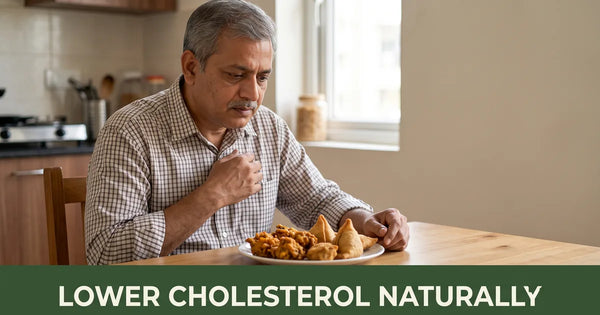
- Favour good fats: mustard oil, a little ghee in moderation, nuts and seeds — and cut trans fats from fried and packaged foods (samosa, bakery items, vanaspati).
- Eat more fibre: oats, whole grains, dals, vegetables and fruit help carry cholesterol out.
- Cut refined sugar and maida — these push triglycerides up.
- Move daily: even a brisk 30-minute walk most days nudges HDL up and triglycerides down.
- Lose excess belly weight, limit alcohol, and stop smoking — each directly improves your lipid picture.
- Take prescribed medication regularly if your doctor has started it, and re-test as advised.
When to See a Doctor
Get a lipid profile if you are over 20 and haven't tested in a few years, or sooner if you have diabetes, high blood pressure, obesity, or a family history of early heart disease. See your doctor promptly if a report shows high LDL, high triglycerides or low HDL, so your overall risk can be assessed and a plan made for you. Never start or stop cholesterol medicine on your own.
How Cholesterol Support Capsules Fit In
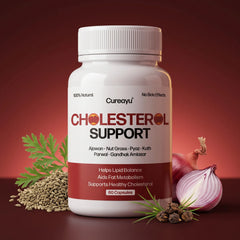
Managing cholesterol is mostly about diet, activity and, when needed, your doctor's prescription. Cureayu Cholesterol Support Capsules is an Ayurvedic formulation traditionally used to help maintain healthy cholesterol levels and support heart wellness as part of a balanced routine.
It is a wellness supplement meant to sit alongside a heart-healthy lifestyle and medical care — not a treatment or cure for high cholesterol or heart disease. If you take cholesterol or heart medication, please consult your physician before adding any supplement.
Frequently Asked Questions
What is a normal cholesterol level by age? For most adults, a desirable total cholesterol is below 200 mg/dL, LDL below 100, HDL above 40 (men) or 50 (women), and triglycerides below 150. Adult targets don't change much by age, though risk increases as you get older.
What is the normal range for LDL and HDL? LDL below 100 mg/dL is considered optimal (lower is better), while HDL of 60 or above is protective — you want HDL higher, not lower.
Is total cholesterol of 200 normal? Below 200 mg/dL is desirable; 200–239 is borderline-high. A single value is read together with your LDL, HDL, triglycerides and overall risk, so discuss it with your doctor.
What level of cholesterol is dangerous? A total cholesterol of 240 mg/dL or more, LDL of 160 or more, or triglycerides of 200 or more are flagged as high and warrant a doctor's review of your heart risk.
Can Ayurveda cure high cholesterol? No. High cholesterol needs a doctor's assessment and sometimes prescription medicine. Ayurvedic herbs such as Arjuna and Guggul may be used traditionally to support healthy lipids and heart wellness alongside treatment, never instead of it.
Written & medically reviewed by Dr. Istuti, BAMS — in-house Ayurvedic physician at Cureayu, focused on metabolic and heart wellness. Dr. Istuti reviews every health article for medical accuracy and compliant, patient-first guidance.
Medically reviewed on October 10, 2026.
Disclaimer: This content is for educational purposes and is not a substitute for professional medical advice. Consult a qualified physician before starting any supplement, especially if you have a kidney/prostate condition or take medication.
Sources
- MedlinePlus — Cholesterol Levels: What You Need to Know: https://medlineplus.gov/cholesterollevelswhatyouneedtoknow.html
- National Heart, Lung, and Blood Institute (NHLBI) — Blood Cholesterol: https://www.nhlbi.nih.gov/health/blood-cholesterol
- CDC — LDL and HDL Cholesterol and Triglycerides: https://www.cdc.gov/cholesterol/about/ldl-and-hdl-cholesterol-and-triglycerides.html
- Ministry of AYUSH, Government of India: https://www.ayush.gov.in/
Internal links: High Cholesterol: Symptoms & Warning Signs (/blogs/heart-care/high-cholesterol-symptoms-warning-signs) · How to Reduce Cholesterol Naturally (/blogs/heart-care/how-to-reduce-cholesterol-naturally) · Heart-Healthy Foods (/blogs/heart-care/heart-healthy-foods) · PDP: Cholesterol Support Capsules (/products/cholesterol-support-capsules-for-healthy-cholesterol-levels)
Disclaimer: Educational content, not a substitute for professional medical advice. Consult a qualified physician before starting any supplement.