
Hypothyroidism vs Hyperthyroidism: Symptoms & Key Differences

DI
Dr. Istuti ✓ Medically reviewed
Oct 7, 2026 · 6 min read
Hypothyroidism vs Hyperthyroidism: Symptoms & Key Differences

Your thyroid is a small, butterfly-shaped gland in the front of your neck — but it quietly sets the speed of nearly everything in your body: your weight, your energy, your heart rate, your mood, even how warm or cold you feel.

When it misbehaves, it usually goes one of two ways. Either it slows down (hypothyroidism) or it speeds up (hyperthyroidism). The names sound almost the same and the spellings are confusing, but the two conditions pull your body in opposite directions — and telling them apart is the first step to getting the right help.

Thyroid problems are far from rare in India. One widely cited estimate suggests roughly 42 million Indians live with some form of thyroid disorder, and women are affected far more often than men (Indian Journal of Endocrinology & Metabolism).

Key Takeaways

  • Hypothyroidism = an underactive thyroid (too little hormone). Body slows down: weight gain, fatigue, feeling cold, constipation, hair fall.
  • Hyperthyroidism = an overactive thyroid (too much hormone). Body speeds up: weight loss, racing heart, feeling hot, anxiety, loose motions.
  • They are diagnosed mainly by a blood test — TSH, usually with T3 and T4.
  • Hypothyroidism is the more common of the two in India.
  • Both are very manageable, but they are medical conditions that need a doctor’s diagnosis — not self-treatment.

The simplest way to remember the difference

Think of your thyroid like the accelerator of a car.

  • In hypothyroidism, the accelerator is barely pressed — the whole body runs slow.
  • In hyperthyroidism, the accelerator is stuck down — the whole body runs fast.

That one idea explains almost every symptom below.

Hypothyroidism: when the thyroid is underactive

Here the gland makes too little thyroid hormone, so your metabolism drags. Common signs include:

  • Unexplained weight gain or difficulty losing weight
  • Constant tiredness and sluggishness
  • Feeling cold when others are comfortable
  • Constipation
  • Dry skin and hair, and hair fall
  • Puffy face, especially around the eyes
  • Low mood or mild depression
  • Heavier or irregular periods in women

The most common cause worldwide is an autoimmune condition called Hashimoto’s thyroiditis, where the body’s own immune system gradually reduces the gland’s output. Iodine imbalance and certain medicines can also play a role (NIDDK — Hypothyroidism).

Hyperthyroidism: when the thyroid is overactive

Here the gland makes too much hormone, so everything speeds up. Common signs include:

  • Unexplained weight loss despite a normal or increased appetite
  • A fast or pounding heartbeat (palpitations)
  • Feeling hot and sweating easily
  • Anxiety, irritability or restlessness
  • Trembling hands (a fine tremor)
  • Loose motions or more frequent bowel movements
  • Trouble sleeping
  • Lighter or irregular periods in women
  • Sometimes a visible swelling in the neck (goitre) or bulging eyes

The most common cause is another autoimmune condition, Graves’ disease (MedlinePlus — Hyperthyroidism).

Side-by-side: the quick comparison

What happens Hypothyroidism (underactive) Hyperthyroidism (overactive)
Metabolism Slows down Speeds up
Weight Tends to go up Tends to go down
Temperature Feels cold Feels hot
Heart rate Slower Faster, palpitations
Digestion Constipation Loose motions
Mood Low, sluggish Anxious, restless
Typical TSH High Low

How doctors tell them apart: your TSH report

Symptoms point the way, but a blood test confirms it. The key marker is TSH (Thyroid Stimulating Hormone), often measured alongside T3 and T4.

TSH works a little backwards, which trips people up:

  • A high TSH usually signals an underactive thyroid (hypothyroidism) — the body is shouting at a sluggish gland to work harder.
  • A low TSH usually signals an overactive thyroid (hyperthyroidism).

Most labs treat a TSH of roughly 0.4 to 4.0 mIU/L as the normal reference range, though the exact cut-offs vary by lab and by situation such as pregnancy (MedlinePlus — TSH Test). Only your doctor can read your numbers in the full context of your symptoms.

The Ayurvedic perspective on thyroid balance

Ayurveda doesn’t use the words “hypo-” and “hyper-,” but it does describe imbalances in agni (the body’s metabolic fire) — a sluggish metabolism versus an over-revved one — which maps loosely onto these two states.

Herbs traditionally used in Ayurveda to support healthy thyroid and metabolic function include Kanchanar (Bauhinia variegata), often combined as Kanchanar Guggulu for glandular wellness, and Ashwagandha, valued as an adaptogen for balance and energy. Classical texts emphasise matching the approach to the individual, steady routine, and calm living.

Important: Ayurvedic support is meant to sit alongside proper diagnosis and treatment — never in place of it. If your doctor has prescribed thyroid medication, keep taking it.

Practical, everyday steps

  • Get tested rather than guessing. A simple TSH test settles which way your thyroid is leaning.
  • Eat balanced, home-cooked meals with adequate (not excessive) iodine — regular iodised salt covers most people.
  • Manage stress and sleep — both strongly influence hormones. Yoga, pranayama and a steady routine genuinely help.
  • Stay active at a level that suits how you feel.
  • Take prescribed thyroid medicine exactly as directed, and retest when your doctor advises.

When to see a doctor

Please get a thyroid check if you notice:

  • Unexplained weight gain or weight loss
  • Constant fatigue, or a racing/irregular heartbeat
  • Feeling unusually cold or unusually hot and sweaty
  • A visible swelling in the front of your neck
  • Changes in your periods, mood, or hair that don’t settle

Thyroid disease is common and very treatable — but it needs a real diagnosis. Don’t try to manage suspected thyroid trouble by diet or supplements alone.

Where Thyroid Care fits in

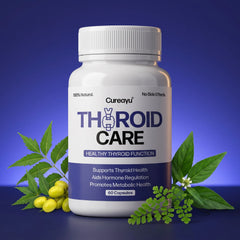
Cureayu Thyroid Care Capsules is an Ayurvedic formulation traditionally used to support healthy thyroid function and metabolism as part of a balanced wellness routine. It is not a replacement for prescribed thyroid medication or for a doctor’s diagnosis. If you have a diagnosed thyroid condition or take thyroid medicine, please consult your physician before adding any supplement.

Related reading: Thyroid symptoms in women · Thyroid diet chart: Indian foods to eat & avoid

FAQ

What is the main difference between hypothyroidism and hyperthyroidism?
Hypothyroidism means the thyroid is underactive and the body slows down (weight gain, fatigue, feeling cold). Hyperthyroidism means it is overactive and the body speeds up (weight loss, palpitations, feeling hot).

Which is more common in India?
Hypothyroidism (the underactive type) is the more common of the two, and it affects women more often than men.

Does a high TSH mean hypo or hyper?
A high TSH usually points to hypothyroidism (underactive), while a low TSH usually points to hyperthyroidism (overactive). Your doctor interprets it with your T3/T4 and symptoms.

Can thyroid problems cause weight changes?
Yes. An underactive thyroid tends to cause weight gain, while an overactive thyroid tends to cause weight loss — which is why unexplained weight change is a classic reason to test.

Can Ayurveda cure thyroid disease?
No — thyroid disease needs proper medical diagnosis and, often, prescription medicine. Ayurvedic herbs may be used traditionally to support thyroid and metabolic wellness alongside your treatment, never instead of it.

Is a swelling in the neck always a thyroid problem?
Not always, but a visible neck swelling (goitre) can be linked to thyroid issues and should be checked by a doctor.


Written & medically reviewed by Dr. Istuti, BAMS — in-house Ayurvedic physician at Cureayu, focused on hormonal and metabolic wellness. Dr. Istuti reviews every health article for medical accuracy and compliant, patient-first guidance.

Medically reviewed on October 7, 2026.

Disclaimer: This content is for educational purposes and is not a substitute for professional medical advice. Consult a qualified physician before starting any supplement, especially if you have a kidney/prostate condition or take medication.
 

Thyroid Care Capsules−20%
MENTIONED IN THIS ARTICLE
Thyroid Care Capsules
★ 4.78 · 170 reviews
₹799 ₹999
DI
Written & reviewed by Dr. Istuti
Ayurvedic physician focused on kidney, urinary and metabolic wellness. Reviews all Cureayu health content. Medically reviewed Oct 19, 2026.

Disclaimer: Educational content, not a substitute for professional medical advice. Consult a qualified physician before starting any supplement.

ShareWAfX⧉

Hypothyroidism vs Hyperthyroidism: Symptoms & Key Differences

DI
Dr. Istuti ✓ Medically reviewed
Oct 7, 2026 · 6 min read
Hypothyroidism vs Hyperthyroidism: Symptoms & Key Differences

Your thyroid is a small, butterfly-shaped gland in the front of your neck — but it quietly sets the speed of nearly everything in your body: your weight, your energy, your heart rate, your mood, even how warm or cold you feel.

When it misbehaves, it usually goes one of two ways. Either it slows down (hypothyroidism) or it speeds up (hyperthyroidism). The names sound almost the same and the spellings are confusing, but the two conditions pull your body in opposite directions — and telling them apart is the first step to getting the right help.

Thyroid problems are far from rare in India. One widely cited estimate suggests roughly 42 million Indians live with some form of thyroid disorder, and women are affected far more often than men (Indian Journal of Endocrinology & Metabolism).

Key Takeaways

  • Hypothyroidism = an underactive thyroid (too little hormone). Body slows down: weight gain, fatigue, feeling cold, constipation, hair fall.
  • Hyperthyroidism = an overactive thyroid (too much hormone). Body speeds up: weight loss, racing heart, feeling hot, anxiety, loose motions.
  • They are diagnosed mainly by a blood test — TSH, usually with T3 and T4.
  • Hypothyroidism is the more common of the two in India.
  • Both are very manageable, but they are medical conditions that need a doctor’s diagnosis — not self-treatment.

The simplest way to remember the difference

Think of your thyroid like the accelerator of a car.

  • In hypothyroidism, the accelerator is barely pressed — the whole body runs slow.
  • In hyperthyroidism, the accelerator is stuck down — the whole body runs fast.

That one idea explains almost every symptom below.

Hypothyroidism: when the thyroid is underactive

Here the gland makes too little thyroid hormone, so your metabolism drags. Common signs include:

  • Unexplained weight gain or difficulty losing weight
  • Constant tiredness and sluggishness
  • Feeling cold when others are comfortable
  • Constipation
  • Dry skin and hair, and hair fall
  • Puffy face, especially around the eyes
  • Low mood or mild depression
  • Heavier or irregular periods in women

The most common cause worldwide is an autoimmune condition called Hashimoto’s thyroiditis, where the body’s own immune system gradually reduces the gland’s output. Iodine imbalance and certain medicines can also play a role (NIDDK — Hypothyroidism).

Hyperthyroidism: when the thyroid is overactive

Here the gland makes too much hormone, so everything speeds up. Common signs include:

  • Unexplained weight loss despite a normal or increased appetite
  • A fast or pounding heartbeat (palpitations)
  • Feeling hot and sweating easily
  • Anxiety, irritability or restlessness
  • Trembling hands (a fine tremor)
  • Loose motions or more frequent bowel movements
  • Trouble sleeping
  • Lighter or irregular periods in women
  • Sometimes a visible swelling in the neck (goitre) or bulging eyes

The most common cause is another autoimmune condition, Graves’ disease (MedlinePlus — Hyperthyroidism).

Side-by-side: the quick comparison

What happens Hypothyroidism (underactive) Hyperthyroidism (overactive)
Metabolism Slows down Speeds up
Weight Tends to go up Tends to go down
Temperature Feels cold Feels hot
Heart rate Slower Faster, palpitations
Digestion Constipation Loose motions
Mood Low, sluggish Anxious, restless
Typical TSH High Low

How doctors tell them apart: your TSH report

Symptoms point the way, but a blood test confirms it. The key marker is TSH (Thyroid Stimulating Hormone), often measured alongside T3 and T4.

TSH works a little backwards, which trips people up:

  • A high TSH usually signals an underactive thyroid (hypothyroidism) — the body is shouting at a sluggish gland to work harder.
  • A low TSH usually signals an overactive thyroid (hyperthyroidism).

Most labs treat a TSH of roughly 0.4 to 4.0 mIU/L as the normal reference range, though the exact cut-offs vary by lab and by situation such as pregnancy (MedlinePlus — TSH Test). Only your doctor can read your numbers in the full context of your symptoms.

The Ayurvedic perspective on thyroid balance

Ayurveda doesn’t use the words “hypo-” and “hyper-,” but it does describe imbalances in agni (the body’s metabolic fire) — a sluggish metabolism versus an over-revved one — which maps loosely onto these two states.

Herbs traditionally used in Ayurveda to support healthy thyroid and metabolic function include Kanchanar (Bauhinia variegata), often combined as Kanchanar Guggulu for glandular wellness, and Ashwagandha, valued as an adaptogen for balance and energy. Classical texts emphasise matching the approach to the individual, steady routine, and calm living.

Important: Ayurvedic support is meant to sit alongside proper diagnosis and treatment — never in place of it. If your doctor has prescribed thyroid medication, keep taking it.

Practical, everyday steps

  • Get tested rather than guessing. A simple TSH test settles which way your thyroid is leaning.
  • Eat balanced, home-cooked meals with adequate (not excessive) iodine — regular iodised salt covers most people.
  • Manage stress and sleep — both strongly influence hormones. Yoga, pranayama and a steady routine genuinely help.
  • Stay active at a level that suits how you feel.
  • Take prescribed thyroid medicine exactly as directed, and retest when your doctor advises.

When to see a doctor

Please get a thyroid check if you notice:

  • Unexplained weight gain or weight loss
  • Constant fatigue, or a racing/irregular heartbeat
  • Feeling unusually cold or unusually hot and sweaty
  • A visible swelling in the front of your neck
  • Changes in your periods, mood, or hair that don’t settle

Thyroid disease is common and very treatable — but it needs a real diagnosis. Don’t try to manage suspected thyroid trouble by diet or supplements alone.

Where Thyroid Care fits in

Cureayu Thyroid Care Capsules is an Ayurvedic formulation traditionally used to support healthy thyroid function and metabolism as part of a balanced wellness routine. It is not a replacement for prescribed thyroid medication or for a doctor’s diagnosis. If you have a diagnosed thyroid condition or take thyroid medicine, please consult your physician before adding any supplement.

Related reading: Thyroid symptoms in women · Thyroid diet chart: Indian foods to eat & avoid

FAQ

What is the main difference between hypothyroidism and hyperthyroidism?
Hypothyroidism means the thyroid is underactive and the body slows down (weight gain, fatigue, feeling cold). Hyperthyroidism means it is overactive and the body speeds up (weight loss, palpitations, feeling hot).

Which is more common in India?
Hypothyroidism (the underactive type) is the more common of the two, and it affects women more often than men.

Does a high TSH mean hypo or hyper?
A high TSH usually points to hypothyroidism (underactive), while a low TSH usually points to hyperthyroidism (overactive). Your doctor interprets it with your T3/T4 and symptoms.

Can thyroid problems cause weight changes?
Yes. An underactive thyroid tends to cause weight gain, while an overactive thyroid tends to cause weight loss — which is why unexplained weight change is a classic reason to test.

Can Ayurveda cure thyroid disease?
No — thyroid disease needs proper medical diagnosis and, often, prescription medicine. Ayurvedic herbs may be used traditionally to support thyroid and metabolic wellness alongside your treatment, never instead of it.

Is a swelling in the neck always a thyroid problem?
Not always, but a visible neck swelling (goitre) can be linked to thyroid issues and should be checked by a doctor.


Written & medically reviewed by Dr. Istuti, BAMS — in-house Ayurvedic physician at Cureayu, focused on hormonal and metabolic wellness. Dr. Istuti reviews every health article for medical accuracy and compliant, patient-first guidance.

Medically reviewed on October 7, 2026.

Disclaimer: This content is for educational purposes and is not a substitute for professional medical advice. Consult a qualified physician before starting any supplement, especially if you have a kidney/prostate condition or take medication.


DI
Written & reviewed by Dr. Istuti
Ayurvedic physician focused on kidney, urinary and metabolic wellness. Reviews all Cureayu health content. Medically reviewed Oct 19, 2026.

Disclaimer: Educational content, not a substitute for professional medical advice. Consult a qualified physician before starting any supplement.