Grade 2 Prostatomegaly: Meaning, Symptoms & When to Worry

DI
Dr. Istuti ✓ Medically reviewed
Oct 16, 2026 · 6 min read
Grade 2 Prostatomegaly: Meaning, Symptoms & When to Worry
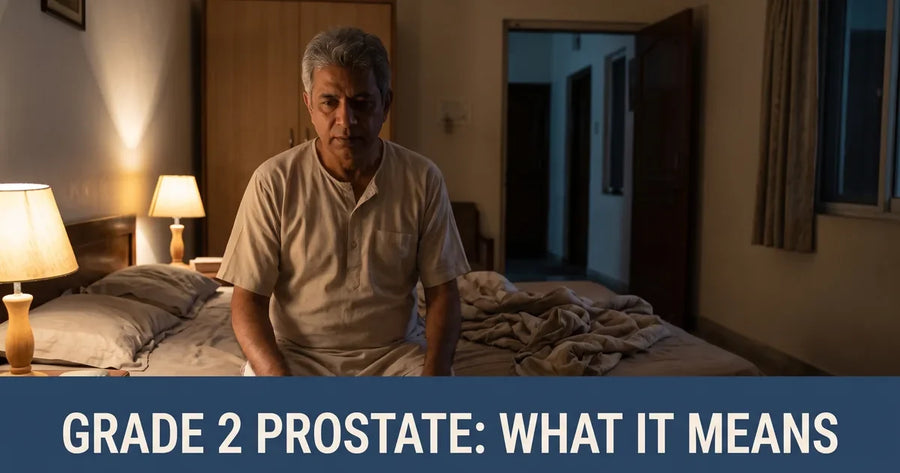
Your ultrasound report says "Grade 2 prostatomegaly" and suddenly your head is full of questions. Is it serious? Is it cancer? Will I need surgery? Take a breath — for most men, this is a common, manageable finding, not an emergency. Here's what Grade 2 prostatomegaly actually means, what to watch for, and when it genuinely needs a doctor's attention.

Key Takeaways

  • Prostatomegaly simply means an enlarged prostate; "Grade 2" usually describes moderate enlargement on ultrasound.
  • A normal adult prostate is roughly 20–25 cc; it's generally called enlarged above about 30 cc. Grade 2 typically falls in a moderate size range (around 30–50 cc) — though grading cut-offs vary between radiologists, so the exact number matters less than your symptoms.
  • Enlargement is not cancer — it's usually benign (BPH). But only your doctor can confirm that, often with a PSA test and examination.
  • Symptoms are urinary: weak stream, going often (especially at night), urgency and a feeling of not fully emptying.
  • Some signs — no urine at all, blood in urine, fever with back pain — need urgent care.

What does Grade 2 prostatomegaly mean?

"Prostatomegaly" is the medical word for an enlarged prostate. On an ultrasound or sonography report, radiologists often grade the enlargement by the prostate's measured volume. Grade 2 generally means moderate enlargement — bigger than a slightly enlarged Grade 1 gland, but not the marked enlargement of Grade 3.

For context: a normal prostate is about the size of a walnut, roughly 20–25 cc (ml), and it's usually considered enlarged on imaging once volume climbs above ~30 cc. Grade 2 commonly sits in a moderate band of around 30–50 cc. Two honest caveats: (1) grading conventions are not perfectly standardised, so one lab's "Grade 2" might be labelled differently elsewhere, and (2) prostate size alone doesn't decide severity — a man with a moderately enlarged gland can have mild symptoms, and vice versa.

Radiologists usually calculate volume with the ellipsoid formula — width × height × length × 0.523 — from the three measured dimensions on the scan.

Grade 1 vs Grade 2 vs Grade 3: the size picture

Grade Rough volume What it usually means
Normal ~20–25 cc Walnut-sized, typical adult prostate
Grade 1 ~25–30 cc Mild / early enlargement
Grade 2 ~30–50 cc Moderate enlargement
Grade 3 ~50–80 cc Marked enlargement
Grade 4 >80 cc Severe enlargement

These ranges are indicative. Different radiologists and textbooks use slightly different cut-offs, so always read your grade alongside your symptoms and your doctor's assessment — not as a standalone verdict.

Is Grade 2 prostatomegaly dangerous? Is it cancer?

This is the fear behind most searches, so let's be clear: an enlarged prostate is not the same as prostate cancer. The most common reason a prostate enlarges with age is benign prostatic hyperplasia (BPH) — "benign" meaning non-cancerous — the same process behind most early enlarged-prostate symptoms. BPH is extremely common in men as they get older.

That said, enlargement and cancer can both exist, and only a doctor can tell them apart. That's why your physician may recommend a PSA (prostate-specific antigen) blood test, a digital rectal exam, and sometimes further tests — to rule out other causes and check how much the enlargement is affecting your urine flow and bladder. Grade 2 on its own is rarely an emergency, but it's a clear prompt to get a proper urology review rather than to panic.

Common symptoms at Grade 2

A moderately enlarged prostate presses on the urethra and bladder, producing what doctors call lower urinary tract symptoms (LUTS):

  • Weak or slow urine stream, or a stream that stops and starts
  • Frequent urination, especially waking at night to go (nocturia)
  • Urgency — a sudden, hard-to-delay need to urinate
  • Trouble starting, dribbling at the end, or straining
  • A feeling of incomplete emptying — the bladder never feels truly empty
  • Occasionally, frequent urges with only small amounts passing

If these are mild, many men manage with lifestyle steps and monitoring. If they're disrupting sleep, work or daily life, that's worth telling your doctor.

The Ayurvedic perspective

Ayurveda views prostate and urinary-flow issues largely through aggravated Vata affecting the mutravaha srotas (urinary channels), often described under conditions like mutraghata (obstructed or difficult urine flow). The classical aim is to support smooth downward flow of urine and ease around the bladder outlet.

Several herbs are traditionally used in this space:

  • Varuna (Crataeva nurvala) — described in classical Ayurvedic texts for urinary wellness and smooth flow.
  • Gokshura (Tribulus terrestris) — traditionally used to support urinary comfort and healthy flow.
  • Kanchanar (Bauhinia variegata) — traditionally used to support healthy glandular tissue.
  • Shilajit and Punarnava — traditionally used in men's urinary and vitality formulations.

These are supportive wellness traditions. They are meant to complement — not replace — medical evaluation and any treatment your doctor advises.

Practical lifestyle & diet steps

Small daily habits genuinely help urinary comfort with a moderately enlarged prostate:

  • Time your fluids. Drink well through the day but cut back 2–3 hours before bed to reduce night-time trips. Don't under-drink overall unless your doctor advises it.
  • Go easy on caffeine and alcohol — both irritate the bladder and worsen urgency.
  • Double void — after you finish, wait a moment and try again to empty more fully.
  • Don't hold it in for long stretches, and give yourself unhurried time in the washroom.
  • Stay active and manage weight — regular walking supports prostate and urinary health.
  • Eat prostate-friendly foods — tomatoes (lycopene), pumpkin seeds, and plenty of vegetables fit an Indian diet easily.
  • Review your medicines with a doctor — some cold and allergy medicines can worsen urinary symptoms.

When to see a doctor

Book a proper check-up for persistent symptoms — and seek urgent care if you have any of these:

  • Sudden inability to pass urine at all (acute retention) — this is an emergency.
  • Blood in the urine.
  • Fever with back or side pain (possible infection reaching the kidneys).
  • Worsening dribbling, pain, or a sense of never emptying the bladder.
  • Any new symptom alongside a rising PSA your doctor is tracking.

Early review means simpler management and peace of mind.

How Prostate Care fits

Alongside the lifestyle steps above, Prostate Care is our Ayurvedic formulation with herbs like Varuna and Gokshura, traditionally used to support healthy urinary flow and everyday prostate comfort in men. It's designed to sit within a routine of good habits and regular medical review — not to replace your doctor's assessment or any prescribed treatment.

FAQ

1. Is Grade 2 prostatomegaly serious? It's usually moderate and manageable, not an emergency. It does mean you should get a urology review to confirm the cause (usually benign BPH) and check your urine flow and bladder.

2. Can Grade 2 prostatomegaly be reduced naturally? Lifestyle steps (fluid timing, limiting caffeine/alcohol, staying active) and medical treatment can ease symptoms. Any claim of a guaranteed, natural way to "shrink" the prostate should be treated with caution — talk to your doctor about realistic options.

3. What is the normal prostate size, and when is it "enlarged"? Normal is roughly 20–25 cc; it's generally called enlarged above about 30 cc. Grade 2 typically means a moderate size, often around 30–50 cc.

4. Does Grade 2 prostatomegaly mean I need surgery? Not usually. Many men are managed with lifestyle measures, monitoring and — if the doctor advises — medication. Surgery is considered mainly for severe or complicated cases.

5. Is Grade 2 prostatomegaly cancer? No — enlargement is most often benign (BPH). But because enlargement and cancer can coexist, your doctor may use a PSA test and exam to be sure.

6. Why do I wake up so many times at night to urinate? Night-time urination (nocturia) is one of the most common symptoms of an enlarged prostate. Cutting fluids before bed and limiting evening caffeine/alcohol often helps — mention it to your doctor if it persists.


Written & medically reviewed by Dr. Istuti, BAMS — Ayurvedic physician (Bachelor of Ayurvedic Medicine and Surgery) at Cureayu, focused on men's urinary and prostate wellness. Medically reviewed on 16 October 2026.

Disclaimer: This content is for educational purposes and is not a substitute for professional medical advice. Consult a qualified physician before starting any supplement, especially if you have a kidney/prostate condition or take medication.

Prostate Care Capsules−27%
MENTIONED IN THIS ARTICLE
Prostate Care Capsules
★ 4.72 · 1063 reviews
₹649 ₹899
DI
Written & reviewed by Dr. Istuti
Ayurvedic physician focused on kidney, urinary and metabolic wellness. Reviews all Cureayu health content. Medically reviewed Oct 19, 2026.

Disclaimer: Educational content, not a substitute for professional medical advice. Consult a qualified physician before starting any supplement.

ShareWAfX⧉

Grade 2 Prostatomegaly: Meaning, Symptoms & When to Worry

DI
Dr. Istuti ✓ Medically reviewed
Oct 16, 2026 · 6 min read
Grade 2 Prostatomegaly: Meaning, Symptoms & When to Worry

Your ultrasound report says "Grade 2 prostatomegaly" and suddenly your head is full of questions. Is it serious? Is it cancer? Will I need surgery? Take a breath — for most men, this is a common, manageable finding, not an emergency. Here's what Grade 2 prostatomegaly actually means, what to watch for, and when it genuinely needs a doctor's attention.

Key Takeaways

  • Prostatomegaly simply means an enlarged prostate; "Grade 2" usually describes moderate enlargement on ultrasound.
  • A normal adult prostate is roughly 20–25 cc; it's generally called enlarged above about 30 cc. Grade 2 typically falls in a moderate size range (around 30–50 cc) — though grading cut-offs vary between radiologists, so the exact number matters less than your symptoms.
  • Enlargement is not cancer — it's usually benign (BPH). But only your doctor can confirm that, often with a PSA test and examination.
  • Symptoms are urinary: weak stream, going often (especially at night), urgency and a feeling of not fully emptying.
  • Some signs — no urine at all, blood in urine, fever with back pain — need urgent care.

What does Grade 2 prostatomegaly mean?

"Prostatomegaly" is the medical word for an enlarged prostate. On an ultrasound or sonography report, radiologists often grade the enlargement by the prostate's measured volume. Grade 2 generally means moderate enlargement — bigger than a slightly enlarged Grade 1 gland, but not the marked enlargement of Grade 3.

For context: a normal prostate is about the size of a walnut, roughly 20–25 cc (ml), and it's usually considered enlarged on imaging once volume climbs above ~30 cc. Grade 2 commonly sits in a moderate band of around 30–50 cc. Two honest caveats: (1) grading conventions are not perfectly standardised, so one lab's "Grade 2" might be labelled differently elsewhere, and (2) prostate size alone doesn't decide severity — a man with a moderately enlarged gland can have mild symptoms, and vice versa.

Radiologists usually calculate volume with the ellipsoid formula — width × height × length × 0.523 — from the three measured dimensions on the scan.

Grade 1 vs Grade 2 vs Grade 3: the size picture

Grade Rough volume What it usually means
Normal ~20–25 cc Walnut-sized, typical adult prostate
Grade 1 ~25–30 cc Mild / early enlargement
Grade 2 ~30–50 cc Moderate enlargement
Grade 3 ~50–80 cc Marked enlargement
Grade 4 >80 cc Severe enlargement

These ranges are indicative. Different radiologists and textbooks use slightly different cut-offs, so always read your grade alongside your symptoms and your doctor's assessment — not as a standalone verdict.

Is Grade 2 prostatomegaly dangerous? Is it cancer?

This is the fear behind most searches, so let's be clear: an enlarged prostate is not the same as prostate cancer. The most common reason a prostate enlarges with age is benign prostatic hyperplasia (BPH) — "benign" meaning non-cancerous — the same process behind most early enlarged-prostate symptoms. BPH is extremely common in men as they get older.

That said, enlargement and cancer can both exist, and only a doctor can tell them apart. That's why your physician may recommend a PSA (prostate-specific antigen) blood test, a digital rectal exam, and sometimes further tests — to rule out other causes and check how much the enlargement is affecting your urine flow and bladder. Grade 2 on its own is rarely an emergency, but it's a clear prompt to get a proper urology review rather than to panic.

Common symptoms at Grade 2

A moderately enlarged prostate presses on the urethra and bladder, producing what doctors call lower urinary tract symptoms (LUTS):

  • Weak or slow urine stream, or a stream that stops and starts
  • Frequent urination, especially waking at night to go (nocturia)
  • Urgency — a sudden, hard-to-delay need to urinate
  • Trouble starting, dribbling at the end, or straining
  • A feeling of incomplete emptying — the bladder never feels truly empty
  • Occasionally, frequent urges with only small amounts passing

If these are mild, many men manage with lifestyle steps and monitoring. If they're disrupting sleep, work or daily life, that's worth telling your doctor.

The Ayurvedic perspective

Ayurveda views prostate and urinary-flow issues largely through aggravated Vata affecting the mutravaha srotas (urinary channels), often described under conditions like mutraghata (obstructed or difficult urine flow). The classical aim is to support smooth downward flow of urine and ease around the bladder outlet.

Several herbs are traditionally used in this space:

  • Varuna (Crataeva nurvala) — described in classical Ayurvedic texts for urinary wellness and smooth flow.
  • Gokshura (Tribulus terrestris) — traditionally used to support urinary comfort and healthy flow.
  • Kanchanar (Bauhinia variegata) — traditionally used to support healthy glandular tissue.
  • Shilajit and Punarnava — traditionally used in men's urinary and vitality formulations.

These are supportive wellness traditions. They are meant to complement — not replace — medical evaluation and any treatment your doctor advises.

Practical lifestyle & diet steps

Small daily habits genuinely help urinary comfort with a moderately enlarged prostate:

  • Time your fluids. Drink well through the day but cut back 2–3 hours before bed to reduce night-time trips. Don't under-drink overall unless your doctor advises it.
  • Go easy on caffeine and alcohol — both irritate the bladder and worsen urgency.
  • Double void — after you finish, wait a moment and try again to empty more fully.
  • Don't hold it in for long stretches, and give yourself unhurried time in the washroom.
  • Stay active and manage weight — regular walking supports prostate and urinary health.
  • Eat prostate-friendly foods — tomatoes (lycopene), pumpkin seeds, and plenty of vegetables fit an Indian diet easily.
  • Review your medicines with a doctor — some cold and allergy medicines can worsen urinary symptoms.

When to see a doctor

Book a proper check-up for persistent symptoms — and seek urgent care if you have any of these:

  • Sudden inability to pass urine at all (acute retention) — this is an emergency.
  • Blood in the urine.
  • Fever with back or side pain (possible infection reaching the kidneys).
  • Worsening dribbling, pain, or a sense of never emptying the bladder.
  • Any new symptom alongside a rising PSA your doctor is tracking.

Early review means simpler management and peace of mind.

How Prostate Care fits

Alongside the lifestyle steps above, Prostate Care is our Ayurvedic formulation with herbs like Varuna and Gokshura, traditionally used to support healthy urinary flow and everyday prostate comfort in men. It's designed to sit within a routine of good habits and regular medical review — not to replace your doctor's assessment or any prescribed treatment.

FAQ

1. Is Grade 2 prostatomegaly serious? It's usually moderate and manageable, not an emergency. It does mean you should get a urology review to confirm the cause (usually benign BPH) and check your urine flow and bladder.

2. Can Grade 2 prostatomegaly be reduced naturally? Lifestyle steps (fluid timing, limiting caffeine/alcohol, staying active) and medical treatment can ease symptoms. Any claim of a guaranteed, natural way to "shrink" the prostate should be treated with caution — talk to your doctor about realistic options.

3. What is the normal prostate size, and when is it "enlarged"? Normal is roughly 20–25 cc; it's generally called enlarged above about 30 cc. Grade 2 typically means a moderate size, often around 30–50 cc.

4. Does Grade 2 prostatomegaly mean I need surgery? Not usually. Many men are managed with lifestyle measures, monitoring and — if the doctor advises — medication. Surgery is considered mainly for severe or complicated cases.

5. Is Grade 2 prostatomegaly cancer? No — enlargement is most often benign (BPH). But because enlargement and cancer can coexist, your doctor may use a PSA test and exam to be sure.

6. Why do I wake up so many times at night to urinate? Night-time urination (nocturia) is one of the most common symptoms of an enlarged prostate. Cutting fluids before bed and limiting evening caffeine/alcohol often helps — mention it to your doctor if it persists.


Written & medically reviewed by Dr. Istuti, BAMS — Ayurvedic physician (Bachelor of Ayurvedic Medicine and Surgery) at Cureayu, focused on men's urinary and prostate wellness. Medically reviewed on 16 October 2026.

Disclaimer: This content is for educational purposes and is not a substitute for professional medical advice. Consult a qualified physician before starting any supplement, especially if you have a kidney/prostate condition or take medication.

DI
Written & reviewed by Dr. Istuti
Ayurvedic physician focused on kidney, urinary and metabolic wellness. Reviews all Cureayu health content. Medically reviewed Oct 19, 2026.

Disclaimer: Educational content, not a substitute for professional medical advice. Consult a qualified physician before starting any supplement.