Grade 1 Prostatomegaly: What It Means and When to Worry

DI
Dr. Istuti ✓ Medically reviewed
Oct 8, 2026 · 6 min read
Grade 1 Prostatomegaly: What It Means and When to Worry
Grade 1 Prostatomegaly: What It Means and When to Worry

Your ultrasound report says “Grade 1 prostatomegaly” and now you’re staring at the words wondering how serious they are. Take a breath — in most men this is the mildest, most common finding of all, and understanding exactly what it means will put the worry in proportion.

Key Takeaways

  • Prostatomegaly simply means an enlarged prostate gland. “Grade 1” is the mildest category.
  • It is not cancer and is usually part of the normal, age-related enlargement doctors call BPH (benign prostatic hyperplasia).
  • Many men with grade 1 enlargement have few or no symptoms and need only monitoring.
  • What matters more than the grade is your symptoms — weak stream, night-time urination, incomplete emptying.
  • Ayurvedic herbs like Varuna, Gokshura and Kaunch are traditionally used to support healthy prostate and urinary function.

What does “prostatomegaly” actually mean?

The prostate is a walnut-sized gland that sits below the bladder and surrounds the urethra (the tube that carries urine out). “Prostatomegaly” is the medical word for an enlarged prostate — prostato (prostate) + megaly (enlargement). On a sonography report it’s often described by grade, which reflects how enlarged the gland looks and roughly how much it’s pushing into the bladder.

A normal adult prostate is around 20–25 grams (cc). As men age, it tends to grow slowly — a process that’s extremely common after 40 and nearly universal by the 70s.

Understanding the grades

Radiologists commonly describe prostate enlargement in grades, usually based on estimated weight/volume and how far it protrudes into the bladder:

  • Grade 1 — mild enlargement (roughly ~25–40 g). The smallest, most common finding. Often minimal or no symptoms.
  • Grade 2 — moderate enlargement (roughly ~40–60 g). Symptoms are more likely.
  • Grade 3 — marked enlargement (roughly ~60–80 g), more likely to affect urine flow.
  • Grade 4 — severe enlargement (above ~80 g), usually with significant symptoms.

(Exact cut-offs vary between labs, so read your grade alongside the volume in grams and, most importantly, your symptoms.)

So grade 1 prostatomegaly is the reassuring end of the scale — a mildly enlarged gland, very typical for an ageing prostate.

Is grade 1 prostatomegaly dangerous? Is it cancer?

This is the fear behind the search, so let’s be clear: prostatomegaly is not prostate cancer. It describes benign (non-cancerous) enlargement — the same thing as BPH. An enlarged prostate and prostate cancer are separate issues, and having one does not mean you have the other. We explain this fully in our guide to the difference between BPH and prostate cancer.

Grade 1 enlargement itself is not dangerous. It becomes worth acting on only when it causes bothersome urinary symptoms or, rarely, blocks the bladder. Your doctor may still suggest a PSA blood test or examination to rule other things out — that’s routine caution, not a red flag.

Symptoms that can come with an enlarged prostate

Because the prostate wraps around the urethra, enlargement can press on that tube and change how you urinate. With grade 1, symptoms are often mild or absent, but watch for:

  • A weak or slow urine stream, or having to strain.
  • Waking at night to urinate (nocturia).
  • Frequency and urgency — going often, or feeling you can’t wait.
  • A sense of incomplete emptying — still feeling full after you go.
  • Dribbling at the end, or a stop-start flow.

Our posts on frequent night-time urination (bar bar peshab aana) and prostatitis vs other prostate problems go deeper into these symptoms.

The Ayurvedic perspective

In Ayurveda, urinary complaints in older men fall under mutraghata (obstruction of urine flow), linked largely to an aggravated Vata dosha with age. The aim is to keep the urinary channels (mutravaha srotas) open and the pelvic tissues well-supported, rather than to “shrink” the gland forcibly.

Herbs traditionally used in this context include:

  • Varuna (Crataeva nurvala) — classically described for the urinary tract and smooth urine flow.
  • Gokshura (Gokhru) — traditionally used to support urinary comfort and flow.
  • Kaunch (Kapikacchu) and Shilajit — used in men’s wellness formulations for vitality.

These are supportive measures for urinary comfort and healthy prostate function — not a cure for BPH — and work best alongside the lifestyle steps below.

Practical steps for a mildly enlarged prostate

Simple daily habits that many men find help with urinary comfort:

  • Don’t hold urine for long; empty the bladder fully, and try “double voiding” (go, wait, go again).
  • Cut evening fluids, caffeine and alcohol to reduce night-time trips.
  • Stay active — regular walking and pelvic-floor (Kegel) exercises support bladder control. See our prostate exercises guide.
  • Eat prostate-friendly foods — tomatoes (lycopene), pumpkin seeds, and plenty of vegetables.
  • Manage weight, blood sugar and blood pressure, which influence urinary health.
  • Review medicines with your doctor — some cold and allergy drugs can worsen flow.

When to see a doctor

Book a visit — don’t just monitor — if you have:

  • Inability to urinate at all, or severe difficulty (this is an emergency).
  • Blood in the urine or semen.
  • Burning, pain or fever with urinary symptoms.
  • Symptoms that are worsening, disturbing your sleep, or affecting daily life.
  • Any PSA concern or a family history of prostate cancer. See our guide to normal prostate size by age and early symptoms of an enlarged prostate.

A urologist can confirm whether your grade 1 finding needs anything more than watchful waiting.

Where Prostate Care fits

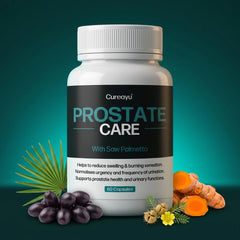
If mild enlargement is affecting your urinary comfort, Cureayu Prostate Care Capsules bring together Ayurvedic herbs such as Varuna and Gokshura that are traditionally used to support healthy prostate function and smooth urinary flow, as part of a daily wellness routine. It supports comfort and function — it is not a treatment or cure for BPH. If your symptoms are significant, or you take other medication, use it under your doctor’s guidance.

FAQ

Q: What does grade 1 prostatomegaly mean?
A: It means mild, early enlargement of the prostate gland — the smallest grade. It’s a benign, age-related change (BPH) and is usually not serious on its own.

Q: Is grade 1 prostatomegaly curable or does it go away?
A: Age-related enlargement doesn’t usually reverse on its own, but grade 1 often needs no treatment — just monitoring and lifestyle measures. Many men live comfortably with it for years.

Q: Does grade 1 prostatomegaly turn into cancer?
A: No. Prostatomegaly (BPH) and prostate cancer are different conditions. Having a benign enlarged prostate does not turn into or cause cancer, though your doctor may still check PSA to be thorough.

Q: What is the normal size of the prostate?
A: A normal adult prostate is roughly 20–25 grams (cc). Grade 1 enlargement is often in the ~25–40 g range.

Q: Can grade 1 prostatomegaly be managed without surgery?
A: Mild cases are usually managed with lifestyle changes and monitoring; surgery is reserved for significant obstruction. Always follow your doctor’s advice for your specific case.

Q: Which Ayurvedic herbs are used for prostate health?
A: Varuna, Gokshura and Kaunch are traditionally used to support healthy prostate and urinary function. They are supportive, not a cure, and should complement medical care.


Written & medically reviewed by Dr. Istuti, BAMS — in-house Ayurvedic physician at Cureayu. Dr. Istuti works on men’s urinary and prostate wellness, combining classical Ayurvedic practice with evidence-aware guidance for Indian patients and families.
Medically reviewed on 8 October 2026.

Disclaimer: This content is for educational purposes and is not a substitute for professional medical advice. Consult a qualified physician before starting any supplement, especially if you have a kidney/prostate condition or take medication.

Sources


Prostate Care Capsules−27%
MENTIONED IN THIS ARTICLE
Prostate Care Capsules
★ 4.72 · 1063 reviews
₹649 ₹899
DI
Written & reviewed by Dr. Istuti
Ayurvedic physician focused on kidney, urinary and metabolic wellness. Reviews all Cureayu health content. Medically reviewed Oct 8, 2026.

Disclaimer: Educational content, not a substitute for professional medical advice. Consult a qualified physician before starting any supplement.
ShareWAfX⧉

Grade 1 Prostatomegaly: What It Means and When to Worry

DI
Dr. Istuti ✓ Medically reviewed
Oct 8, 2026 · 6 min read
Grade 1 Prostatomegaly: What It Means and When to Worry

Grade 1 Prostatomegaly: What It Means and When to Worry

Your ultrasound report says “Grade 1 prostatomegaly” and now you’re staring at the words wondering how serious they are. Take a breath — in most men this is the mildest, most common finding of all, and understanding exactly what it means will put the worry in proportion.

Key Takeaways

  • Prostatomegaly simply means an enlarged prostate gland. “Grade 1” is the mildest category.
  • It is not cancer and is usually part of the normal, age-related enlargement doctors call BPH (benign prostatic hyperplasia).
  • Many men with grade 1 enlargement have few or no symptoms and need only monitoring.
  • What matters more than the grade is your symptoms — weak stream, night-time urination, incomplete emptying.
  • Ayurvedic herbs like Varuna, Gokshura and Kaunch are traditionally used to support healthy prostate and urinary function.

What does “prostatomegaly” actually mean?

The prostate is a walnut-sized gland that sits below the bladder and surrounds the urethra (the tube that carries urine out). “Prostatomegaly” is the medical word for an enlarged prostate — prostato (prostate) + megaly (enlargement). On a sonography report it’s often described by grade, which reflects how enlarged the gland looks and roughly how much it’s pushing into the bladder.

A normal adult prostate is around 20–25 grams (cc). As men age, it tends to grow slowly — a process that’s extremely common after 40 and nearly universal by the 70s.

Understanding the grades

Radiologists commonly describe prostate enlargement in grades, usually based on estimated weight/volume and how far it protrudes into the bladder:

  • Grade 1 — mild enlargement (roughly ~25–40 g). The smallest, most common finding. Often minimal or no symptoms.
  • Grade 2 — moderate enlargement (roughly ~40–60 g). Symptoms are more likely.
  • Grade 3 — marked enlargement (roughly ~60–80 g), more likely to affect urine flow.
  • Grade 4 — severe enlargement (above ~80 g), usually with significant symptoms.

(Exact cut-offs vary between labs, so read your grade alongside the volume in grams and, most importantly, your symptoms.)

So grade 1 prostatomegaly is the reassuring end of the scale — a mildly enlarged gland, very typical for an ageing prostate.

Is grade 1 prostatomegaly dangerous? Is it cancer?

This is the fear behind the search, so let’s be clear: prostatomegaly is not prostate cancer. It describes benign (non-cancerous) enlargement — the same thing as BPH. An enlarged prostate and prostate cancer are separate issues, and having one does not mean you have the other. We explain this fully in our guide to the difference between BPH and prostate cancer.

Grade 1 enlargement itself is not dangerous. It becomes worth acting on only when it causes bothersome urinary symptoms or, rarely, blocks the bladder. Your doctor may still suggest a PSA blood test or examination to rule other things out — that’s routine caution, not a red flag.

Symptoms that can come with an enlarged prostate

Because the prostate wraps around the urethra, enlargement can press on that tube and change how you urinate. With grade 1, symptoms are often mild or absent, but watch for:

  • A weak or slow urine stream, or having to strain.
  • Waking at night to urinate (nocturia).
  • Frequency and urgency — going often, or feeling you can’t wait.
  • A sense of incomplete emptying — still feeling full after you go.
  • Dribbling at the end, or a stop-start flow.

Our posts on frequent night-time urination (bar bar peshab aana) and prostatitis vs other prostate problems go deeper into these symptoms.

The Ayurvedic perspective

In Ayurveda, urinary complaints in older men fall under mutraghata (obstruction of urine flow), linked largely to an aggravated Vata dosha with age. The aim is to keep the urinary channels (mutravaha srotas) open and the pelvic tissues well-supported, rather than to “shrink” the gland forcibly.

Herbs traditionally used in this context include:

  • Varuna (Crataeva nurvala) — classically described for the urinary tract and smooth urine flow.
  • Gokshura (Gokhru) — traditionally used to support urinary comfort and flow.
  • Kaunch (Kapikacchu) and Shilajit — used in men’s wellness formulations for vitality.

These are supportive measures for urinary comfort and healthy prostate function — not a cure for BPH — and work best alongside the lifestyle steps below.

Practical steps for a mildly enlarged prostate

Simple daily habits that many men find help with urinary comfort:

  • Don’t hold urine for long; empty the bladder fully, and try “double voiding” (go, wait, go again).
  • Cut evening fluids, caffeine and alcohol to reduce night-time trips.
  • Stay active — regular walking and pelvic-floor (Kegel) exercises support bladder control. See our prostate exercises guide.
  • Eat prostate-friendly foods — tomatoes (lycopene), pumpkin seeds, and plenty of vegetables.
  • Manage weight, blood sugar and blood pressure, which influence urinary health.
  • Review medicines with your doctor — some cold and allergy drugs can worsen flow.

When to see a doctor

Book a visit — don’t just monitor — if you have:

  • Inability to urinate at all, or severe difficulty (this is an emergency).
  • Blood in the urine or semen.
  • Burning, pain or fever with urinary symptoms.
  • Symptoms that are worsening, disturbing your sleep, or affecting daily life.
  • Any PSA concern or a family history of prostate cancer. See our guide to normal prostate size by age and early symptoms of an enlarged prostate.

A urologist can confirm whether your grade 1 finding needs anything more than watchful waiting.

Where Prostate Care fits

If mild enlargement is affecting your urinary comfort, Cureayu Prostate Care Capsules bring together Ayurvedic herbs such as Varuna and Gokshura that are traditionally used to support healthy prostate function and smooth urinary flow, as part of a daily wellness routine. It supports comfort and function — it is not a treatment or cure for BPH. If your symptoms are significant, or you take other medication, use it under your doctor’s guidance.

FAQ

Q: What does grade 1 prostatomegaly mean?
A: It means mild, early enlargement of the prostate gland — the smallest grade. It’s a benign, age-related change (BPH) and is usually not serious on its own.

Q: Is grade 1 prostatomegaly curable or does it go away?
A: Age-related enlargement doesn’t usually reverse on its own, but grade 1 often needs no treatment — just monitoring and lifestyle measures. Many men live comfortably with it for years.

Q: Does grade 1 prostatomegaly turn into cancer?
A: No. Prostatomegaly (BPH) and prostate cancer are different conditions. Having a benign enlarged prostate does not turn into or cause cancer, though your doctor may still check PSA to be thorough.

Q: What is the normal size of the prostate?
A: A normal adult prostate is roughly 20–25 grams (cc). Grade 1 enlargement is often in the ~25–40 g range.

Q: Can grade 1 prostatomegaly be managed without surgery?
A: Mild cases are usually managed with lifestyle changes and monitoring; surgery is reserved for significant obstruction. Always follow your doctor’s advice for your specific case.

Q: Which Ayurvedic herbs are used for prostate health?
A: Varuna, Gokshura and Kaunch are traditionally used to support healthy prostate and urinary function. They are supportive, not a cure, and should complement medical care.


Written & medically reviewed by Dr. Istuti, BAMS — in-house Ayurvedic physician at Cureayu. Dr. Istuti works on men’s urinary and prostate wellness, combining classical Ayurvedic practice with evidence-aware guidance for Indian patients and families.
Medically reviewed on 8 October 2026.

Disclaimer: This content is for educational purposes and is not a substitute for professional medical advice. Consult a qualified physician before starting any supplement, especially if you have a kidney/prostate condition or take medication.

Sources


DI
Written & reviewed by Dr. Istuti
Ayurvedic physician focused on kidney, urinary and metabolic wellness. Reviews all Cureayu health content. Medically reviewed Oct 8, 2026.

Disclaimer: Educational content, not a substitute for professional medical advice. Consult a qualified physician before starting any supplement.